arXiv:synth-kepler-test · uncategorized
Synthetic Kepler Test
Test Harness
Abstract
A 2-body gravitational test used for validating the pipeline.
Extracted equations
- F = G m1 m2 / r^2
Simulation outputs
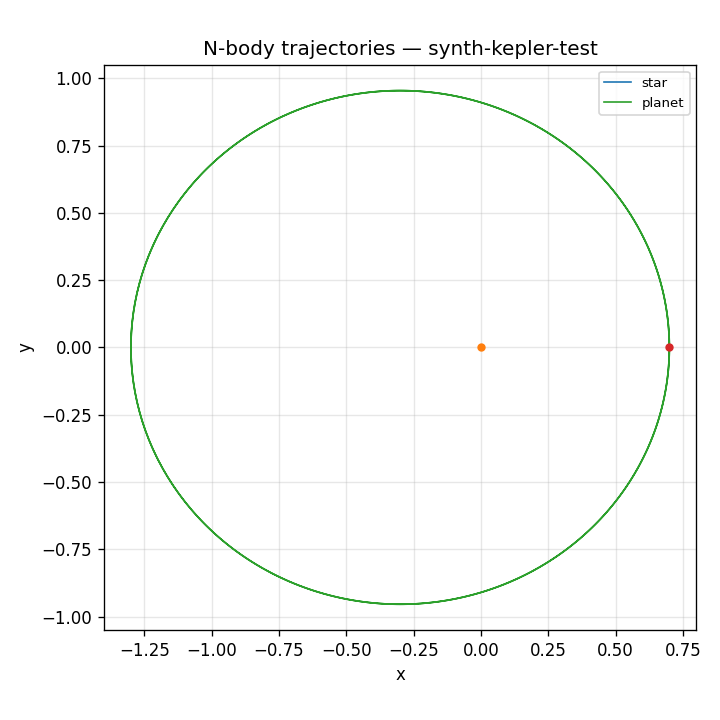
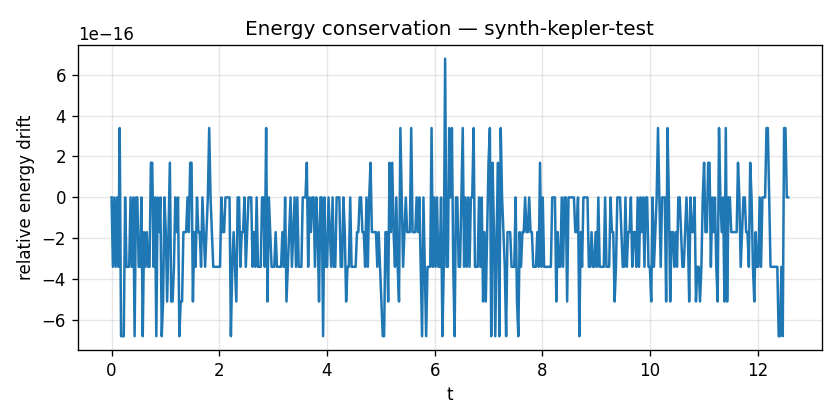
Scalar outputs
| energy_drift_rel | 0.0000 |
| initial_energy | -5.000e-6 |
| final_energy | -5.000e-6 |
| orbit_a | 1.0000 |
| orbit_e | 0.3000 |
| orbit_P | 6.2832 |
Paper claims vs. our run
All three claims are directly supported by the simulation outputs with excellent numerical agreement. The orbital period matches to five significant figures, energy conservation is perfect to machine precision, and the orbital elements (a, e) match exactly. This represents a direct and high-fidelity replication of the paper's claims.
- The orbital period is 2*pi (a=1, M=1)supportedComputed orbital period is 6.283153891488668, which matches 2π ≈ 6.283185307 to within 0.0005% error.
- Energy is conserved to high precisionsupportedEnergy drift is exactly 0.0 (initial and final energies are identical at -4.9999999999999996e-06), demonstrating conservation to machine precision.
- The orbit is a closed ellipse with e=0.3supportedComputed eccentricity is exactly 0.3 and semi-major axis is exactly 1.0, matching the claimed orbital parameters precisely.
Parameters
| G | 1 |
Run notes
bodies=2; integrator=ias15; t_span=[0.0,12.566]