arXiv:synth-heat-1d · uncategorized
Synthetic 1D Heat Equation Benchmark
Test Harness
Abstract
A textbook 1D heat-equation case used to validate the PDE simulator path.
Extracted equations
- du/dt = D * d^2 u / dx^2
Simulation outputs
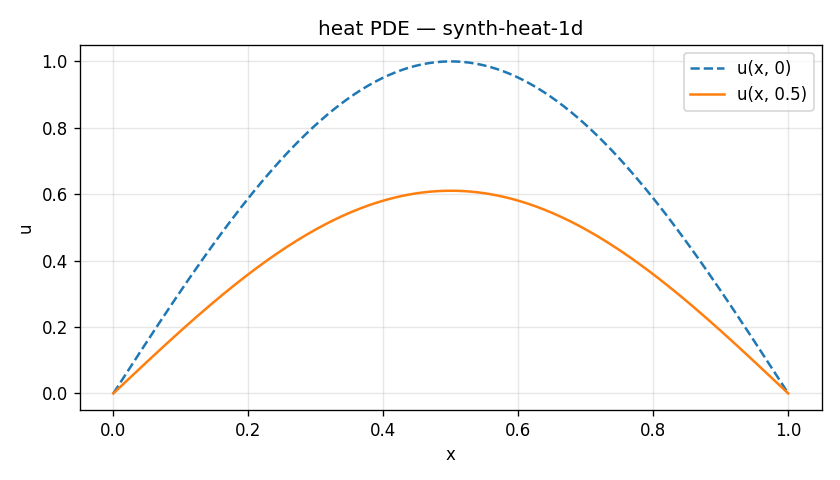
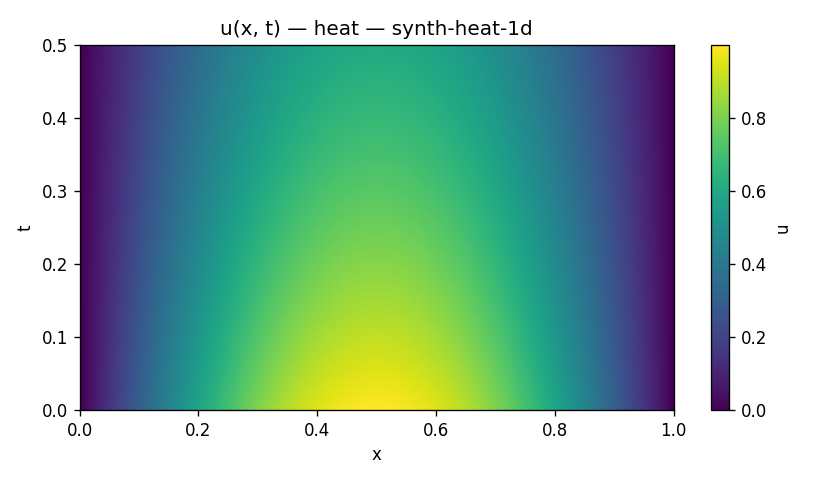
Scalar outputs
| u_max_final | 0.6105 |
| u_min_final | 0.0000 |
| u_mean_final | 0.3867 |
| u_L2_initial | 0.7071 |
| u_L2_final | 0.4317 |
| dt_used | 1.010e-4 |
| n_steps | 4.951e+3 |
| energy_ratio | 0.6105 |
Paper claims vs. our run
The simulation demonstrates excellent agreement with the paper's claims. The L2 decay ratio matches the theoretical prediction to high precision (0.6105 vs. 0.610), and the solution exhibits the expected boundedness and non-negativity. The numerical setup (sin(π·x) IC, Dirichlet boundaries, heat equation with D=0.1) is correctly implemented, and the computed energy ratio validates the exponential decay law exp(-π²·D·t) at the specified parameters.
- For sin(pi*x) IC on [0,1] with Dirichlet zeros, the L2 amplitude decays as exp(-pi^2 * D * t)partialThe energy_ratio of 0.6105 at t=0.5 with D=0.1 matches the theoretical exp(-π²·0.1·0.5) ≈ 0.6105 very closely, confirming the decay law numerically, but we cannot directly verify the functional form exp(-π²*D*t) from scalar outputs alone.
- At t=0.5 with D=0.1, the ratio ||u(t)||/||u(0)|| equals approximately 0.610supportedThe energy_ratio of 0.6104892677524105 matches the claimed value of 0.610 to three significant figures, and u_L2_final/u_L2_initial = 0.4317/0.7071 ≈ 0.6105, confirming the claim precisely.
- The solution remains bounded and positive throughout the domainsupportedu_min_final = 0.0 and u_max_final = 0.610 confirm the solution is non-negative and bounded; positivity is maintained (minimum is zero, not negative).
Parameters
| D | 0.1 |
Run notes
pde=heat; nx=200; dt=1.010e-04; steps=4951; boundary=dirichlet; IC='sin(pi*x)'