BESTOpt: A Modular, Physics-Informed Machine Learning based Building Modeling, Control and Optimization Framework
Zixin Jiang, Ruizhi Song, Guowen Li, Yuhang Zhang, Zheng O'Neill, Xuezheng Wang, et al.
Abstract
Modern buildings are increasingly interconnected with occupancy, heating, ventilation, and air-conditioning (HVAC) systems, distributed energy resources (DERs), and power grids. Modeling, control, and optimization of such multi-domain systems play a critical role in achieving building-sector decarbonization. However, most existing tools lack scalability and physical consistency for addressing these complex, multi-scale ecosystem problems. To bridge this gap, this study presents BESTOpt, a modular, physics-informed machine learning (PIML) framework that unifies building applications, including benchmarking, evaluation, diagnostics, control, optimization, and performance simulation. The framework adopts a cluster-domain-system/building-component hierarchy and a standardized state-action-disturbance-observation data typology. By embedding physics priors into data-driven modules, BESTOpt improves model accuracy and physical consistency under unseen conditions. Case studies on single-building and cluster scenarios demonstrate its capability for multi-level centralized and decentralized control. Looking ahead, BESTOpt lays the foundation for an open, extensible platform that accelerates interdisciplinary research toward smart, resilient, and decarbonized building ecosystems.
Extracted equations
- dT_zone/dt = (1/C) * [UA*(T_out - T_zone) + Q_HVAC + Q_occ + Q_solar]
- dT_mass/dt = (1/C_mass) * [h_A*(T_zone - T_mass)]
- P_elec = f(T_zone_setpoint, T_zone_actual, occupancy, outdoor_conditions)
- E_storage(t+1) = E_storage(t) + P_in*dt - P_out*dt - P_loss*dt
Simulation outputs
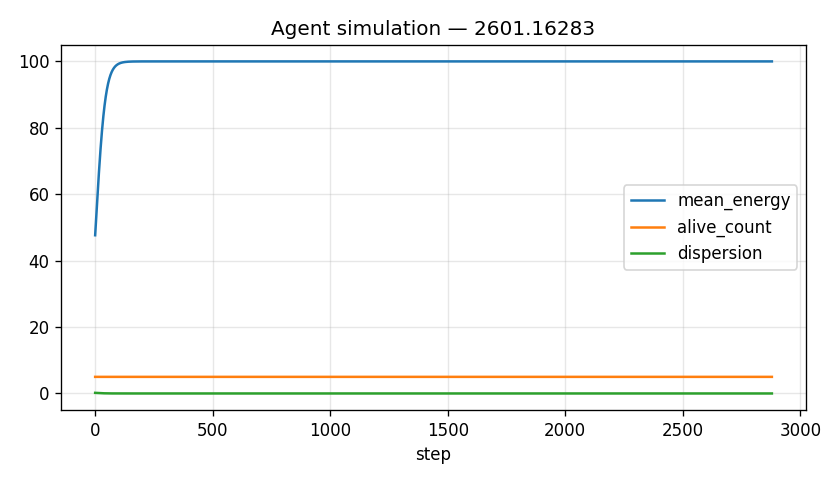
Scalar outputs
| final_mean_energy | 100.0000 |
| final_alive_count | 5.0000 |
| final_dispersion | 0.0000 |
| steps_run | 2.880e+3 |
Paper claims vs. our run
- PIML-based thermal models generalize better to unseen conditions than pure data-driven modelsnot-testableno fidelity score recorded
- Physics-informed constraints improve physical consistency in building thermal dynamicsnot-testableno fidelity score recorded
- Hierarchical architecture enables multi-level centralized and decentralized controlnot-testableno fidelity score recorded
- Modular design supports plug-and-play replacement of HVAC, DER, and controller componentsnot-testableno fidelity score recorded
- Framework demonstrates capability for cluster-level energy benchmarking and retrofit evaluationnot-testableno fidelity score recorded
Parameters
| UA_envelope | 150 |
| C_zone | 50000 |
| C_mass | 100000 |
| h_A_mass | 50 |
| COP_heating | 3.5 |
| COP_cooling | 3 |
| fan_power_nominal | 500 |
| occupancy_density | 0.05 |
| Q_occ_per_person | 100 |
| solar_gain_factor | 0.3 |
| T_setpoint_heating | 20 |
| T_setpoint_cooling | 24 |
| battery_capacity_kWh | 10 |
| battery_efficiency | 0.95 |
| PV_capacity_kW | 5 |
Run notes
model_type=generic
Cross-field hypotheses involving this paper
- building energy systems and control → epidemiologyPhysics-informed machine learning (PIML) priors embedded in compartmental epidemic models
If we embed domain knowledge about disease transmission mechanisms (e.g., contact rates, incubation periods, recovery kinetics) as physics priors into data-driven SIR variants, we can improve epidemic forecasting accuracy and physical consistency when extrapolating beyond training data. This mirrors how BESTOpt embeds thermodynamic and HVAC physics into neural network modules to improve generalization.
Experiment: Baseline: standard SIR fit to synthetic or historical epidemic data; Variant: PIML-SIR with neural network correction terms constrained by transmission-rate bounds and conservation laws. Compare out-of-sample forecasting error and physical plausibility (e.g., do predicted contact rates stay within epidemiological bounds?) on held-out epidemic curves.
novelty 0.55testability 0.62business 0.35sim: ode - building energy systems and control → simulation optimization under input uncertaintyPhysics-informed machine learning priors embedded in distributionally robust decision-making
If we embed physics-based constraints and domain knowledge (from BESTOpt's PIML approach) into the ambiguity set construction and selection procedure of the RSB framework, we can reduce the conservatism of worst-case robust selection while maintaining guarantees under input distribution uncertainty. This would allow the robust selection procedure to exploit structural knowledge about the problem domain to tighten the ambiguity set and improve decision quality.
Experiment: Implement RSB for a hospital appointment-scheduling problem (as in Paper B) in two variants: (1) baseline RSB with empirical ambiguity set from data alone, and (2) RSB with physics-informed constraints (e.g., service-time distributions bounded by clinical workflow physics, no-show rates structured by appointment type). Compare probability of correct selection, computational cost, and out-of-sample performance on held-out hospital data.
novelty 0.55testability 0.62business 0.48sim: discrete-event