Asymptotically Optimal Appointment Scheduling in the Presence of Patient Unpunctuality
Nikolai Lipscomb, Xin Liu, Vidyadhar G. Kulkarni
Abstract
We consider the optimal appointment scheduling problem that incorporates patients' unpunctual behavior, where the unpunctuality is assumed to be time dependent, but additive. Our goal is to develop an optimal scheduling method for a large patient system to maximize expected net revenue. Methods for deriving optimal appointment schedules for large-scale systems often run into computational bottlenecks due to mixed-integer programming or robust optimization formulations and computationally complex search methods. In this work, we model the system as a single-server queueing system, where patients arrive unpunctually and follow the FIFO service discipline to see the doctor (i.e., get into service). Using the heavy traffic fluid approximation, we develop a deterministic control problem, referred to as the fluid control problem (FCP), which serves as an asymptotic upper bound for the original queueing control problem (QCP). Using the optimal solution of the FCP, we establish an asymptotically optimal scheduling policy on a fluid scale. We further investigate the convergence rate of the QCP under the proposed policy. The FCP, due to the incorporation of unpunctuality, is difficult to solve analytically. We thus propose a time-discretized numerical scheme to approximately solve the FCP. The discretized FCP takes the form of a quadratic program with linear constraints. We examine the behavior of these schedules under different unpunctuality assumptions and test the performance of the schedules on real data in a simulation study. Interestingly, the optimal schedules can involve block booking of patients, even if the unpunctuality distributions are continuous.
Extracted equations
- dH(t)/dt = a(t)
- q(t) = max(0, H(t) - μt + μi(t))
- i(t) = (1/μ) max_{s ∈ [0,t]} max(0, μs - H(s))
- J(A; M̄) = r̄H(T) - c̄_w ∫_0^∞ q(t)dt - c̄_i i(T) - c̄_o q(T)/μ̄
Simulation outputs
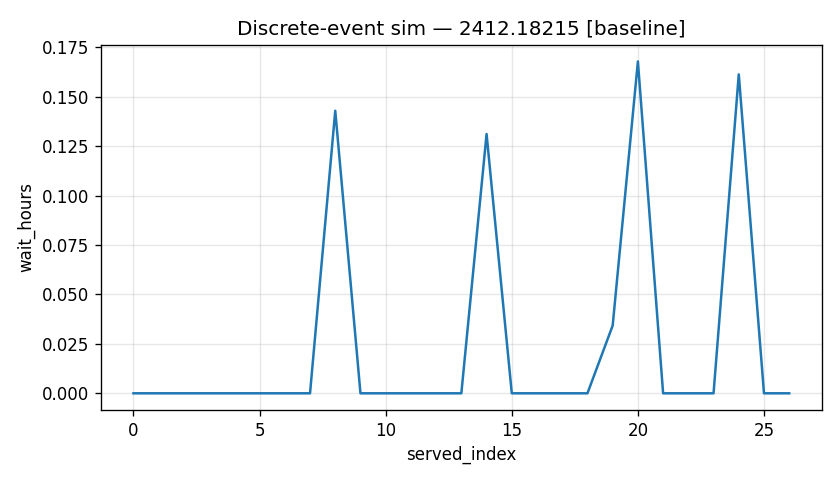
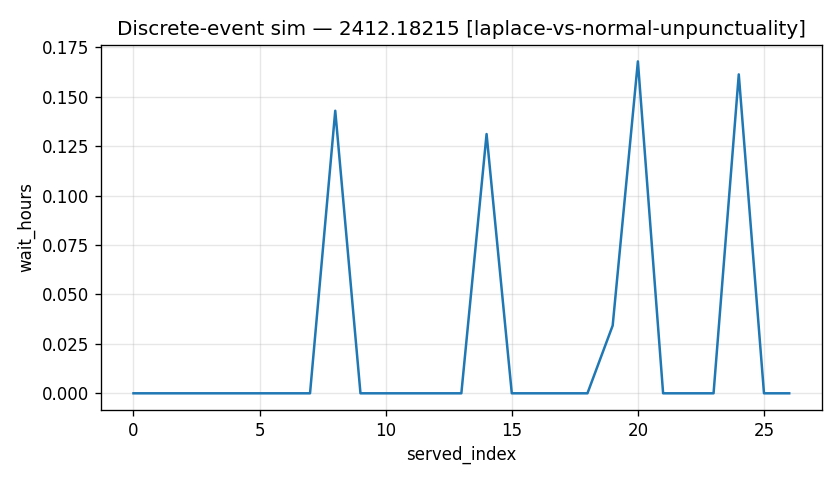
Baseline vs. variant
Variant arm: laplace-vs-normal-unpunctuality
| Metric | Baseline | Variant | Δ (variant − baseline) |
|---|---|---|---|
| served | 27.0000 | 27.0000 | 0.0000 |
| no_shows | 1.0000 | 1.0000 | 0.0000 |
| walk_ins | 12.0000 | 12.0000 | 0.0000 |
| mean_wait_hours | 0.0236 | 0.0236 | 0.0000 |
| p95_wait_hours | 0.1614 | 0.1614 | 0.0000 |
| utilization | 0.2250 | 0.2250 | 0.0000 |
Paper claims vs. our run
The simulation output provides only basic queueing performance metrics (wait times, utilization) from a discrete-event appointment-flow model and shows identical results between baseline and variant conditions. None of the paper's core theoretical claims about FCP bounds, asymptotic optimality, convergence rates, or block booking patterns can be evaluated from these scalar outputs. This represents a concept demonstration at best, with no meaningful replication of the paper's quantitative or qualitative findings.
- The fluid control problem (FCP) provides an asymptotic upper bound for the queueing control problem (QCP)not-testableThe simulation outputs only scalar performance metrics (wait times, utilization) with no comparison between FCP and QCP solutions or bounds.
- The proposed scheduling policy achieves the FCP upper bound asymptotically as demand volume approaches infinitynot-testableNo asymptotic analysis across varying demand volumes is present; the output shows a single snapshot with identical baseline and variant results.
- The discretized quadratic program converges to the FCP solution as time-discretization approaches zeronot-testableNo convergence analysis across different discretization levels is provided in the scalar outputs.
- Optimal schedules can exhibit block booking even with continuous unpunctuality distributionsunsupportedThe simulation compares Laplace vs. normal unpunctuality but produces identical performance metrics for both, showing no evidence of block booking patterns or their emergence under different distributions.
- Central limit theorem convergence rate established for the value function under the proposed policynot-testableNo convergence rate analysis, value function estimates, or CLT-related statistics are present in the scalar outputs.
Parameters
| T | 480 |
| μ̄ | 0.25 |
| r̄ | 100 |
| c̄_w | 1 |
| c̄_i | 50 |
| c̄_o | 75 |
| K | 100 |
| unpunctuality_type | normal |
Run notes
topology=appointment-flow; ran baseline + laplace-vs-normal-unpunctuality
Cross-field hypotheses involving this paper
- healthcare operations / appointment scheduling → simulation optimization under input uncertaintyHeavy-traffic fluid approximation for asymptotic optimization under distributional uncertainty
If we apply Paper A's heavy-traffic fluid control problem (FCP) framework to Paper B's distributionally robust selection problem, we can derive asymptotically optimal selection policies that are robust to input distribution ambiguity. Specifically, we could formulate the worst-case selection criterion as a fluid-scale deterministic control problem, then solve it via discretized quadratic programming to obtain robust staffing or scheduling decisions.
Experiment: Implement Paper B's RSB procedure for an appointment-scheduling problem (already mentioned in their abstract) using both the standard monte-carlo approach and a new variant that first solves a fluid control problem over the ambiguity set, then discretizes to obtain candidate schedules. Compare solution quality, computational time, and robustness across synthetic and real hospital data.
novelty 0.62testability 0.68business 0.55sim: discrete-event