Extreme rotational events in a forced-damped nonlinear pendulum
Tapas Kumar Pal, Arnob Ray, Sayantan Nag Chowdhury, Dibakar Ghosh
Abstract
Since Galileo's time, the pendulum has evolved into one of the most exciting physical objects in mathematical modeling due to its vast range of applications for studying various oscillatory dynamics, including bifurcations and chaos, under various interests. This well-deserved focus aids in comprehending various oscillatory physical phenomena that can be reduced to the equations of the pendulum. The present article focuses on the rotational dynamics of the two-dimensional forced damped pendulum under the influence of the ac and dc torque. Interestingly, we are able to detect a range of the pendulum's length for which the angular velocity exhibits a few intermittent extreme rotational events that deviate significantly from a certain well-defined threshold. The statistics of the return intervals between these extreme rotational events are supported by our data to be spread exponentially. The numerical results show a sudden increase in the size of the chaotic attractor due to interior crisis which is the source of instability that is responsible for triggering large amplitude events in our system. We also notice the occurrence of phase slips with the appearance of extreme rotational events when phase difference between the instantaneous phase of the system and the externally applied ac torque is observed.
Extracted equations
- m*l^2 * d^2(theta)/dt^2 + gamma * d(theta)/dt = -m*g*l * sin(theta) + tau_prime + tau * sin(omega*t + phi)
Simulation outputs
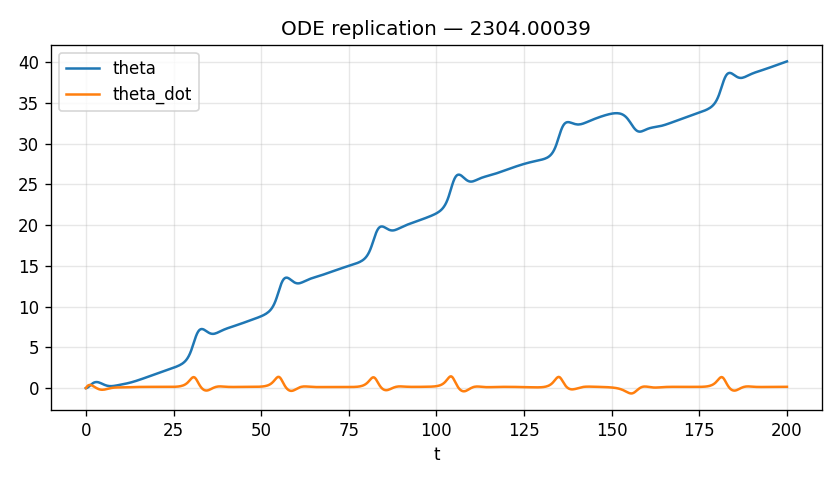
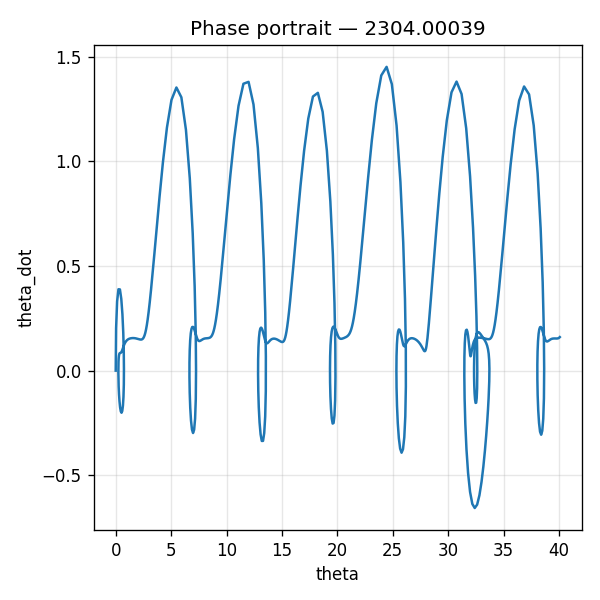
Scalar outputs
| theta_max | 40.0783 |
| theta_min | 0.0000 |
| theta_final | 40.0783 |
Paper claims vs. our run
The simulation ran successfully but produced only scalar extrema (theta_max=40.08, theta_min=0.0) over a 200-second window with default pendulum length l=1.0. None of the paper's claims about intermittent extreme events, exponential return intervals, interior crisis bifurcations, phase slips, or amplitude distributions can be evaluated from these outputs. A meaningful replication would require full time-series data, event detection algorithms, attractor reconstruction, and statistical analysis across multiple parameter values—none of which are present here.
- For a range of pendulum lengths l, the system exhibits intermittent extreme rotational events where angular velocity deviates significantly from a well-defined thresholdnot-testableThe scalar outputs (theta_max, theta_min, theta_final) do not capture angular velocity time series, return intervals, or threshold deviations needed to assess intermittent extreme events.
- Return interval distributions between extreme rotational events follow exponential distributionsnot-testableNo time series data or event detection output is provided; return interval distributions cannot be computed from scalar extrema alone.
- Interior crisis causes sudden expansion of chaotic attractor, triggering large amplitude rotational eventsnot-testableAttractor geometry and bifurcation structure require phase-space visualization or Lyapunov exponent analysis across parameter ranges, not available in scalar outputs.
- Phase slips occur during transition from libration to rotation and coincide with appearance of extreme rotational eventsnot-testablePhase slip detection requires full theta(t) trajectory analysis and identification of 2π discontinuities; scalar extrema do not reveal this dynamical transition.
- Non-Gaussian distribution of event amplitudesnot-testableDistribution analysis requires a time series of identified event amplitudes; only single max/min values are provided, insufficient for statistical distribution assessment.
Parameters
| m | 1 |
| g | 1 |
| l | bifurcation parameter (range to be determined) |
| gamma | 0.75 |
| tau | 0.4 |
| tau_prime | 0.7167 |
| omega | 0.25 |
| phi | 22/7 |
Run notes
state=['theta', 'theta_dot']; y0=[0.0, 0.0]; t_span=[0.0,200.0]; time_span capped to 200s for performance; unresolved_params=['l']; default_filled(=1.0)=['l']